
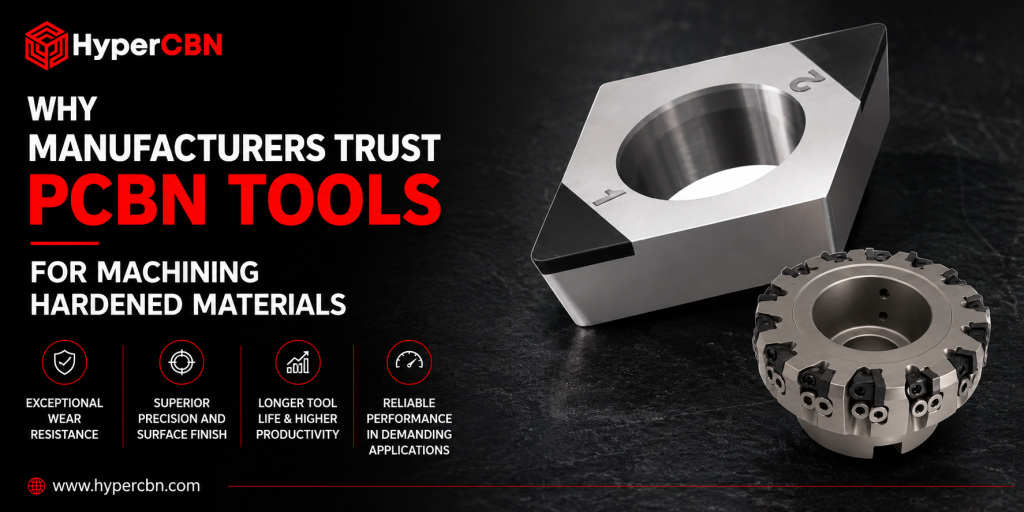
In today’s competitive manufacturing environment, precision, efficiency, and productivity feel like everything, honestly. Industries such as automotive, aerospace, energy, and heavy engineering are constantly searching for advanced cutting solutions that can deal with hardened materials and still keep exceptional accuracy. And this is kind of where PCBN tools show up as a real turning point, so to speak.
At HyperCBN, we get what modern machining is asking for, and we deliver high-performance PCBN tools, cubic boron nitride inserts, and hard turning inserts meant to push productivity forward and also improve machining results day by day.
What Are PCBN Tools?
PCBN tools are cutting tools made using polycrystalline cubic boron nitride (PCBN), which is one of the hardest materials available after diamond. These tools are engineered specifically for machining hardened ferrous materials, the kind that can be a pain when you use standard carbide tools.
The cutting edges are typically built using cubic boron nitride inserts, and they bring strong wear resistance plus thermal stability and durability even when machining conditions get extreme.
That’s why PCBN tools are commonly used in hard turning, finishing, and semi-finishing operations, where consistency and precision matter a lot.
Understanding Cubic Boron Nitride Inserts
Cubic boron nitride inserts are basically the core part of many advanced machining systems. They’re produced by sintering cubic boron nitride particles under high pressure and temperature settings, then formed into the insert shape you need for cutting.
These inserts are set up to machine things like
– Hardened steels
– Cast irons
– Powder metallurgy components
– High-temperature alloys
– Tool steels
– Bearing steels
Because of their composition, cubic boron nitride inserts can keep cutting performance strong even when temperatures climb, which makes them a good match for tough industrial uses.
Key Benefits of PCBN Tools
1. Exceptional hardness
One of the biggest advantages with PCBN stuff is the really incredible durability, like it can take a beating for longer.
In comparison to conventional cutters, PCBN machines can work with materials with a hardness level of more than 45 HRC and still maintain the integrity of the surface.
The benefits are pretty clear, like a
- Reduction in tool wear.
- machining stability is better.
- Longer operational lifespan, and
- Overall cutting performance stays consistently high all the time, even when things get busy.
2. Superior Wear Resistance
Wear resistance affects tool life and also affects production costs. So it matters.
The advanced structure of cubic boron nitride inserts delivers strong resistance to:
- Abrasive wear
- Chemical wear
- Thermal wear
- Crater wear
So manufacturers can push longer machining cycles and don’t have to swap tools as often, which is usually the point.
3. High Thermal Stability
When machining hardened materials, heat generation is extreme.
PCBN tools, in contrast to many typical cutting materials, keep hardness and cutting efficiency even in high-temperature situations.
Benefits:
- A lower thermal deformation
- Improved dimensional fidelity
- More consistent machining quality
- More throughput
4. Excellent Surface Finishing
A more refined surface finish can cut down on the need for secondary grinding operations, you know. It tends to help a lot in practice, really. Hard turning inserts made from PCBN provide a really good surface quality, which helps manufacturers hit tight tolerances and deliver smoother finishes right out of the machining step, without doing so much extra work after.
Applications of PCBN Tools
PCBN tools are pretty versatile, so they work across a lot of industries, even when the manufacturing setup is not exactly simple.
Automotive Industry
Makers use PCBN tools quite often for machining important parts, where you need tight tolerances and pretty steady outcomes, like a stable result that won’t drift too much.
Common Applications
- Transmission gears
- Brake discs
- Bearing races
- Engine components
- Differential parts
The durability of cubic boron nitride inserts helps keep productivity steady, and it also supports strict quality goals.
Aerospace Industry
In aerospace, components must be reliable, and they also need exceptional precision, no exceptions, really.
PCBN tools are often used for
- Landing gear components
- Turbine parts
- Structural assemblies
- High-strength steel components
Because these tools can cut hard materials with precision, they become almost non-negotiable in aerospace production.
Bearing Manufacturing
Bearing parts typically get machining again after heat treatment, so the work can be very demanding on the tool.
Hard turning inserts help with dimensional control, as well as surface quality for
- Inner races
- Outer races
- Roller bearing components
- Precision bearing surfaces
Energy and Power Sector
The energy sector depends on strong machining tools to build components that survive harsh conditions for long periods.
PCBN tools are used to produce stuff like
- Valve seats
- Pump components
- Turbine parts
- Drilling equipment
Why Hard Turning Inserts Are Replacing Grinding Operations
Grinding used to be the go-to method for finishing hardened components. But today many manufacturers lean toward hard-turning inserts, mainly because they tend to be more efficient, and the whole workflow feels more flexible.
Advantages Over Grinding
Faster Production
Hard turning inserts cut down machining time since they let roughing and finishing happen in the same setup, and that saves a surprising amount of effort.
Lower Costs
Companies often reduce
- Machine setup costs
- Tooling expenses
- Maintenance requirements
- Production downtime
Greater Flexibility
When manufacturers use PCBN tools together with advanced hard turning inserts, they can complete multiple machining operations on one machine without too much reshuffling.
Improved Process Control
With hard turning, you usually get
- Better dimensional consistency
- More straightforward automation
- Less production complexity
Factors to Consider When Selecting PCBN Tools
Picking the right PCBN tools matters, because it directly impacts machining results and overall performance.
Workpiece Material
Different grades of cubic boron nitride inserts are made for different materials, so matching them is crucial.
- Think about
- Material hardness
- Alloy composition
- Heat treatment condition
- Surface requirements
Cutting Speed
Higher cutting speeds mean the insert must handle more heat, so thermal resistance becomes a key requirement.
Choosing the right grade of PCBN tools supports stable cutting, and it also helps extend tool life.
Feed Rate and Depth of Cut
Machining parameters change how the tool behaves, so it’s not just about speed.
- A solid mix of
- Cutting speed
- Feed rate
- Depth of cut
will help hard turning inserts do their job more effectively.
Surface Finish Requirements
When an application needs a very clean finish, premium-grade PCBN tools are usually the better choice; they deliver higher precision and consistency compared to generic options.
How PCBN Tools help manufacturing run faster
Most manufacturers are going with PCBN tools lately because they bring real, countable gains in output and speed. Not just marketing, but measurable productivity improvements.
Less tool swapping
Those long-lifespan cubic boron nitride inserts cut down interruptions that happen when you constantly swap out tools. Fewer stops, more steady runs, kind of simple.
Better machine uptime
With higher cutting speeds, plus steadier cutting behavior, machines can stay productive for longer stretches. So utilization goes up, and the shop doesn’t feel as “gappy” between setups.
More consistent product results
When machining stays stable you usually see better workpiece performance like
- Improved dimensional accuracy, and more stable dimensions across batches
- Enhanced surface finishes, smoother and more uniform
- Lower rejection rates, because tolerances stay in control.
- Reduced overall production costs, from less scrap and fewer slowdowns
Sure, PCBN tools can cost more at first, but their longer service life and productivity side effects can reduce total machining cost a lot over time.
Why pick HyperCBN for PCBN tools?
At HyperCBN, we focus on machining solutions that match high industry expectations. We don’t just ship tools; we support the actual process.
Our strong points
- Premium-quality PCBN tools
- High-performance cubic boron nitride inserts
- Durable and reliable hard turning inserts
- Tooling solutions tailored for specific applications
- Consistent product quality, batch after batch
- Expert technical support when you need it
- Options for automotive, aerospace, bearing, and energy industries
Our drive for innovation and precision helps manufacturers hit stronger machining performance, while operational costs drop.
Frequently Asked Questions (FAQs)
1. What are PCBN tools employed to do?
PCBN tools are mostly used to cut hardened steels, casting irons, and bearing steels as well as other materials that are difficult to cut. They are typically used for hard turning and finishing processes.
2. What are cubic boron nitride insertions?
Cubic boron nitride inserts are cutting inserts that are made of one of the most durable synthetic materials that are available. They offer strong heat stability, resistance to wear, and a precise machining experience.
3. Why do you lean toward inserts with hard turning rather than grinding?
Hard-turned inserts can, in practice, cut down on how long it takes to machine, lower the cost per run, and improve flexibility. And in some cases they can almost wipe out the need for certain grinding operations while still maintaining a really good surface quality.
4. Which industries usually put PCBN tools to work?
Common applications include aerospace, automotive bearing manufacturing, and energy production, as well as heavy engineering and precision manufacturing. Additionally, generally wherever difficult-to-machine work takes place.
5. How do PCBN tools improve productivity?
PCBN tools boost productivity since they enable faster cutting speeds, lessen the need for tool changes, provide superior surface quality, cut down on downtime, and reduce the overall cost of machining.