
In today’s advanced manufacturing landscape, it’s kind of all about hitting that sweet spot, you know the one, where you land top-level precision, longer tool life, and better output, because without that competitive edge, it just sort of melts away. You see it everywhere, like in automotive, aerospace, bearing making, energy, and heavy engineering; all of them depend on cutting tools that can machine hardened stuff without falling apart. And yeah, this is exactly why CBN inserts have kind of turned into a must-have solution.
HyperCBN, as a provider of advanced machining solutions, brings premium CBN inserts, PCBN inserts, and CBN cutting tools built to handle the tough realities of modern machining. These tools work especially well in hard turning, so manufacturers can get a better surface finish, less downtime, and overall, more efficient running of the process.
So What Are CBN Inserts Really?
CBN inserts are cutting tools made from Cubic Boron Nitride, or CBN, which is one of the hardest materials out there right after diamond. The material itself is engineered for machining hardened ferrous materials, where regular carbide tools usually struggle to keep up, or they simply lose performance too soon.
You will find these inserts used for hard turning, finishing, and semi-finishing on hardened steels, cast irons, powder metallurgy parts, and superalloys. Unlike traditional carbide inserts, CBN inserts hold up under extreme cutting temperatures, and they keep the edge integrity even when machining conditions get nasty.
Now, understanding PCBN inserts
PCBN inserts are polycrystalline cubic boron nitride inserts. They’re made by bonding multiple CBN crystals together using high pressure and temperature, so you get a stronger overall structure. That polycrystalline style boosts toughness and wear resistance, making PCBN inserts a strong pick for demanding work like:
- Hardened steel components
- Automotive transmission parts
- Bearing rings
- Gear components
- Aerospace alloys
- High-speed finishing jobs
A lot of modern production lines rely on PCBN inserts, since they bring dimensional stability plus steady machining performance, which is what everyone wants when the tolerances are strict.
Why CBN cutting tools are preferred now
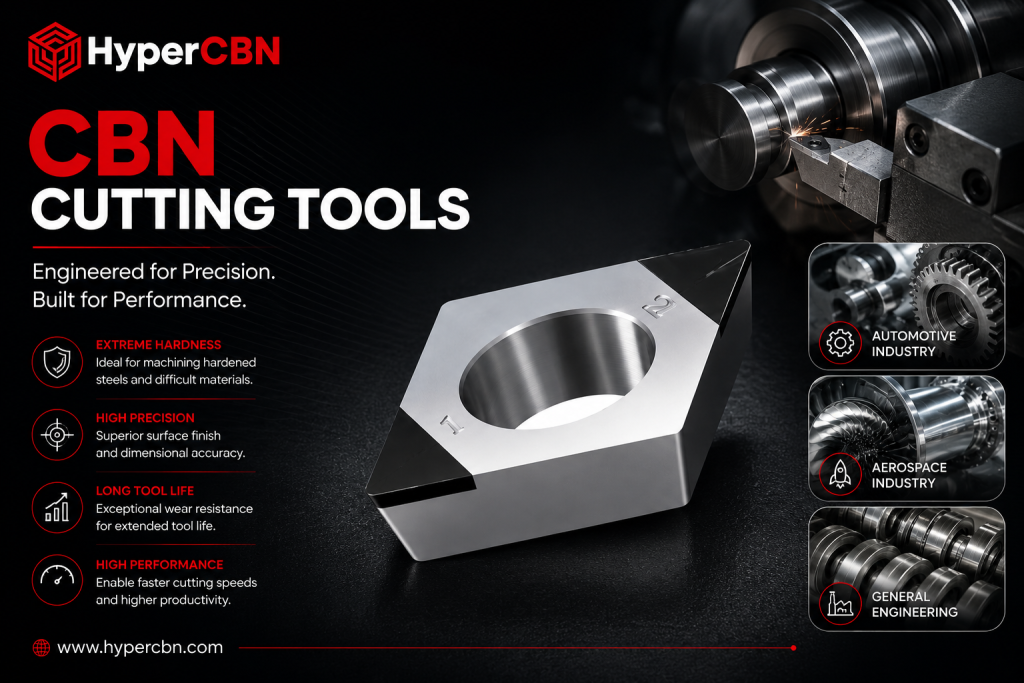
Precision engineering demand has basically pushed CBN cutting tools into the mainstream across multiple industries. A few big reasons show up again and again.
Exceptional Hardness
CBN cutting tools are extremely hard, second only to diamond. That means you can machine hardened materials while resisting fast wear.
High Thermal Stability
They also keep their hardness even when the temperatures climb during high-speed machining, which is not always the case with other cutting materials.
Longer tool life
In many setups, manufacturers see major increases in tool life when using PCBN inserts, which cuts tool change time and lowers machine downtime.
Superior surface finish
The cutting edges tend to be sharp and clean, helping you reach great surface quality and often reduce, or even skip, secondary finishing steps.
Improved productivity
Higher cutting speeds and shorter cycle times help increase output while still holding accuracy.
Key benefits of using CBN inserts
1. Better machining efficiency
One major plus is hard turning at higher speeds than usual, with carbide tools that tend to let you run faster cutting cycles. This usually translates into quicker machining cycles and less production time, plus better machine utilization. In other words, it can support higher throughput without the same kind of slowdown.
So when you’re in high-volume production environments, CBN inserts tend to become a go-to choice, for sure.
2. Strong wear resistance
Wear resistance is a big deal when machining hardened materials. PCBN inserts can offer:
- reduced flank wear
- lower crater wear
- stable cutting performance
- improved dimensional accuracy
That stability leads to better process control during long production runs.
3. Lower manufacturing costs
CBN cutting tools might be a bit pricier at first than carbide, but in the long run the machining cost can shrink. Usually it’s because of a few things that tend to line up, like fewer tool changes, less machine downtime, reduced labor costs, and that steadier production efficiency.
Over time, these advantages sort of stack up until you get actual operational savings.
4. Precision and accuracy
Industries today demand tight tolerances, no negotiation. CBN inserts help achieve:
- high-dimensional accuracy
- better repeatability
- consistent part quality
- reduced rejection rates
And honestly this matters a lot for automotive and aerospace manufacturing, where small deviations can become expensive fast.
Applications of CBN Inserts Across Industries
Honestly, CBN inserts are kind of versatile, so they end up being useful in a lot of different industrial settings, and not just one specific place or process.
Automotive Industry
In the automotive sphere, PCBN inserts are used pretty extensively for machining, like for parts such as:
- Transmission gears
- Brake components
- Bearing races
- Engine parts
- Differential gears
These pieces often need high precision and really clean surface finishes. No one likes rough edges, especially when tolerances are tight.
Bearing Manufacturing
Bearing makers rely on CBN cutting tools to machine hardened bearing rings and races.
The usual outcomes are like:
- Improved roundness
- Better surface finish
- Enhanced dimensional control
- Longer tool life
Aerospace Industry
For aerospace, the expectations are higher than usual; the tolerance and reliability requirements are exceptional.
CBN inserts are commonly used for machining
- Landing gear components
- Aerospace bearings
- Hardened steel parts
- High-strength alloys
The durability of PCBN inserts helps keep results consistent, even when the application is critical, and yeah, this is where failure is not an option.
Heavy Engineering
In heavy engineering, CBN cutting tools are used for
- Hardened shafts
- Roll machining
- Industrial gears
- Hydraulic components
Because CBN inserts handle tough machining conditions, they fit these jobs pretty naturally.
Materials Suitable for CBN Inserts
One of the stronger advantages of CBN inserts is that they can handle hard or difficult materials without going downhill too fast.
Common materials include
Hardened Steel
PCBN inserts are used for hardened steels, typically in the 45 HRC to 70 HRC range.
Cast Iron
CBN cutting tools usually perform well in gray cast iron and alloy cast iron machining.
Powder Metallurgy Components
Manufacturers choose CBN inserts to get strong finishes on powder metal parts. It’s basically about smoother output.
Tool Steel
Tool steels often demand precise machining, so PCBN inserts become a good, practical choice.
Hard-Faced Components
Since CBN cutting tools have strong wear resistance, they support efficient machining on hard-coated surfaces
Choosing the Right CBN Inserts
Choosing the right CBN inserts is crucial if you want solid performance, productivity, and fewer surprises during production.
Consider Material Hardness , since that’s kind of the baseline
Different grades of PCBN inserts are usually built for particular hardness levels, and yes, the matching really matters here. If you get it off, the whole process feels weirdly off too.
Also it helps to understand the workpiece material first, so your tool selection is not random, but on purpose
Evaluate Cutting Conditions, because several bits of input matter, like
- Cutting speed
- Feed rate
- Depth of cut
- Machine rigidity
These variables influence how CBN cutting tools behave, and if you overlook them, you can end up with a rougher finish or a shorter service life.
Determine Surface Finish Requirements
For fine finishing tasks, manufacturers often select specialized CBN inserts with advanced edge geometries because the final look is part of the spec.
Match Insert Grade to Application
Different PCBN inserts are designed for
- Continuous cutting
- Interrupted cutting
- Finishing
- Semi-finishing
- Roughing
Picking the right grade can lift productivity and extend tool life at the same time.
Best Practices for Using CBN Cutting Tools
To get the best results from CBN cutting tools, follow recommended machining practices.
Maintain Machine Stability
Rigid machine setups reduce vibration, and that improves insert performance.
Optimize the cutting settings
Right speed, feed rate, and the like help you get better throughput, plus longer tool service life, which is kind of the goal overall.
Monitor Tool Wear
Regular inspection is important so wear patterns are caught early, and part quality stays consistent.
Use Appropriate Insert Geometry
Correct geometry helps with chip control and cutting stability, which is honestly one of the biggest day-to-day factors.
Follow Manufacturer Recommendations
Using the guidance from HyperCBN helps ensure optimal performance from CBN inserts and PCBN inserts, especially when conditions change from one job to another.
Why Pick HyperCBN for CBN Inserts?
HyperCBN is all about delivering high-performance machining solutions so manufacturers can sort out better outcomes, you know, with less hassle.
Cutting Edge Manufacturing Tech
HyperCBN leans on modern production methods to make premium CBN inserts plus PCBN inserts, with an emphasis on repeatable results, not guesswork.
Steady, reliable quality
Every insert goes through strict checks, like really careful verification, and again it passes. The goal is kind of straightforward: dependable performance, even when the cutting gets tough, like really tough.
Big Selection, Many Options
HyperCBN brings a broad collection of CBN cutting tools for different machining needs, ranging from small batch work to heavy production stuff.
Real Technical Know-How
Their experienced specialists assist you to pick the most fitting CBN inserts based on what you’re really running in production, not just the generic specs, and sometimes you can see the difference fast.
Proven Results in the Real World
All around the world, manufacturers count on HyperCBN for precision machining, extended tool life, and higher productivity too. It’s not marketing hype; it’s what people do day after day, with the results showing up in practice.
CBN Inserts Are Shaping Tomorrow’s Precision Machining
As manufacturing keeps evolving, the demand for efficient hard turning solutions is only going up. Companies are always looking for smart ways to lower costs, lift quality, and speed things up in day-to-day operations.
CBN inserts, PCBN inserts, and upgraded CBN cutting tools are helping meet those goals. Because they can slice hardened materials with firm accuracy and pretty solid efficiency, they end up mattering a lot in today’s modern manufacturing plans, in general.
When organizations decide on high-quality CBN inserts, they often get a kind of edge, like faster throughput, cleaner faces on the work, and less day-to-day operating expense later on.
With creative solutions from HyperCBN, manufacturers can tackle today’s machining obstacles while also getting ready for what the industry will ask next.
Frequently Asked Questions (FAQs)
1. What are CBN inserts used for?
CBN inserts are mainly used to machine hardened steels, cast irons, bearing parts, gears, and other hard materials that need high precision plus a clean surface.
2. What is the difference between CBN inserts and PCBN inserts?
CBN inserts are made from CBN, that boron nitride material, but PCBN inserts are sort of a specific style where polycrystalline cubic boron nitride is used. Basically, with PCBN, multiple CBN crystals get bonded together so you end up with improved toughness and, yeah, higher wear resistance.
3. Why are CBN cutting tools preferred over carbide tools?
CBN cutting tools tend to give you more hardness, better resistance to wear, stronger thermal stability, longer tool life, and more consistent cutting performance, especially when you’re machining hardened materials. With carbide, you usually don’t get the same steadier behavior, not under those harsh conditions, not in the same way.
4. Which industries usually use CBN inserts
A lot of times you’ll see them in Automotive, aerospace, and bearing manufacturing, plus heavy engineering, power generation, and tool manufacturing also, CBN inserts and PCBN inserts get used pretty regularly, for things that need that extra edge, you know
5. How can I pick the right CBN insert for my application?
Choosing the correct CBN insert depends on factors like the workpiece material, its hardness, the cutting conditions, what kind of surface finish you’re expecting, and the machining type you’re running. If you talk to HyperCBN experts, they can help point you toward the most suitable CBN cutting tools for your use case.